Archived notebook
It demonstrates the same class as the Charge Line example. Use Charge Line instead. This page is kept at its URL and is not part of the learning path; see Archived notebooks.
Note
This page was generated from circuit-examples/A.Qubits/07-Transmon_floating_cl.ipynb.
Single Transmon - Floating with charge lines
We’ll be creating a 2D design and adding a single transmon qcomponent with charge lines.
Create a standard pocket transmon qubit with charge lines for a ground plane, with two pads connected by a junction.


💡 Running in Colab or Binder? Skip the desktop GUI install — the cell below grabs the lite (no-Qt) wheel, and
qm.gui(design)auto-picks an inline matplotlib viewer with the same API (gui.rebuild(),gui.screenshot(),gui.edit_component(...)) as the desktopMetalGUI.
[ ]:
# In Colab / Binder, uncomment to install Quantum Metal (lite, no Qt).
# Locally you should already have it via `pip install quantum-metal` or
# `pip install 'quantum-metal[gui]'` for the desktop GUI.
# !pip install -q quantum-metal
💡 Using this tutorial without the Qt GUI
This tutorial uses the desktop
MetalGUI. To follow along on Colab, Binder, JupyterHub, or any environment where Qt isn’t available, replace any ``gui.rebuild()`` / ``gui.screenshot()`` call with ``qm.view(design)`` — it renders the design to a matplotlibFigureyou can display inline or save withfig.savefig(...).See 1.1 Quick start for a complete runnable walkthrough and
`docs/headless-usage.rst<https://qiskit-community.github.io/qiskit-metal/headless-usage.html>`__ for the full reference.
[ ]:
import qiskit_metal as metal
from qiskit_metal import designs, draw
from qiskit_metal import MetalGUI, Dict, open_docs
[ ]:
# Each time you create a new quantum circuit design,
# you start by instantiating a QDesign class.

# The design class `DesignPlanar` is best for 2D circuit designs.

design = designs.DesignPlanar()
[ ]:
# Launch Qiskit Metal GUI to interactively view, edit, and simulate QDesign: Metal GUI
gui = MetalGUI(design)
[ ]:
# To force overwrite a QComponent with an existing name.
# This is useful when re-running cells in a notebook.
design.overwrite_enabled = True
A transmon qubit
You can create a ready-made transmon qubit with charge lines from the QComponent Library, qiskit_metal.qlibrary.qubits. transmon_pocket_cl.py is the file containing our qubit so transmon_pocket_cl is the module we import. The TransmonPocketCL class is our transmon qubit. Like all quantum components, TransmonPocketCL inherits from QComponent.
Connector lines can be added using the connection_pads dictionary. Each connector pad has a name and a list of default properties.
[6]:
from qiskit_metal.qlibrary.qubits.transmon_pocket_cl import TransmonPocketCL

# Be aware of the default_options that can be overridden by user.
TransmonPocketCL.get_template_options(design)
[6]:
{'pos_x': '0um',
 'pos_y': '0um',
 'connection_pads': {},
 '_default_connection_pads': {'pad_gap': '15um',
  'pad_width': '125um',
  'pad_height': '30um',
  'pad_cpw_shift': '5um',
  'pad_cpw_extent': '25um',
  'cpw_width': 'cpw_width',
  'cpw_gap': 'cpw_gap',
  'cpw_extend': '100um',
  'pocket_extent': '5um',
  'pocket_rise': '65um',
  'loc_W': '+1',
  'loc_H': '+1'},
 'chip': 'main',
 'pad_gap': '30um',
 'inductor_width': '20um',
 'pad_width': '455um',
 'pad_height': '90um',
 'pocket_width': '650um',
 'pocket_height': '650um',
 'orientation': '0',
 'make_CL': True,
 'cl_gap': '6um',
 'cl_width': '10um',
 'cl_length': '20um',
 'cl_ground_gap': '6um',
 'cl_pocket_edge': '0',
 'cl_off_center': '50um',
 'hfss_wire_bonds': False,
 'q3d_wire_bonds': False,
 'hfss_inductance': '10nH',
 'hfss_capacitance': 0,
 'hfss_resistance': 0,
 'hfss_mesh_kw_jj': 7e-06,
 'q3d_inductance': '10nH',
 'q3d_capacitance': 0,
 'q3d_resistance': 0,
 'q3d_mesh_kw_jj': 7e-06,
 'gds_cell_name': 'my_other_junction'}
[ ]:
transmon_options = dict(
    pos_x="1mm",
    pos_y="2mm",
    orientation="90",
    connection_pads=dict(
        a=dict(loc_W=+1, loc_H=-1, pad_width="70um", cpw_extend="50um"),
        b=dict(
            loc_W=-1, loc_H=-1, pad_width="125um", cpw_extend="50um", pad_height="60um"
        ),
        c=dict(loc_W=+1, loc_H=+1, pad_width="110um", cpw_extend="50um"),
    ),
    gds_cell_name="FakeJunction_01",
)

# Create a new Transmon Pocket object with name 'Q1'
q1 = TransmonPocketCL(design, "Q1", options=transmon_options)

gui.rebuild()  # rebuild the design and plot
gui.autoscale()  # resize GUI to see QComponent
gui.zoom_on_components(["Q1"])  # Can also gui.zoom_on_components([q1.name])
Let’s see what the Q1 object looks like
[8]:
q1 # print Q1 information
[8]:
name:    Q1
class:   TransmonPocketCL
options:
  'pos_x'             : '1mm',
  'pos_y'             : '2mm',
  'connection_pads'   : {
       'a'                 : {
            'pad_gap'           : '15um',
            'pad_width'         : '70um',
            'pad_height'        : '30um',
            'pad_cpw_shift'     : '5um',
            'pad_cpw_extent'    : '25um',
            'cpw_width'         : 'cpw_width',
            'cpw_gap'           : 'cpw_gap',
            'cpw_extend'        : '50um',
            'pocket_extent'     : '5um',
            'pocket_rise'       : '65um',
            'loc_W'             : 1,
            'loc_H'             : -1,
                             },
       'b'                 : {
            'pad_gap'           : '15um',
            'pad_width'         : '125um',
            'pad_height'        : '60um',
            'pad_cpw_shift'     : '5um',
            'pad_cpw_extent'    : '25um',
            'cpw_width'         : 'cpw_width',
            'cpw_gap'           : 'cpw_gap',
            'cpw_extend'        : '50um',
            'pocket_extent'     : '5um',
            'pocket_rise'       : '65um',
            'loc_W'             : -1,
            'loc_H'             : -1,
                             },
       'c'                 : {
            'pad_gap'           : '15um',
            'pad_width'         : '110um',
            'pad_height'        : '30um',
            'pad_cpw_shift'     : '5um',
            'pad_cpw_extent'    : '25um',
            'cpw_width'         : 'cpw_width',
            'cpw_gap'           : 'cpw_gap',
            'cpw_extend'        : '50um',
            'pocket_extent'     : '5um',
            'pocket_rise'       : '65um',
            'loc_W'             : 1,
            'loc_H'             : 1,
                             },
                        },
  'chip'              : 'main',
  'pad_gap'           : '30um',
  'inductor_width'    : '20um',
  'pad_width'         : '455um',
  'pad_height'        : '90um',
  'pocket_width'      : '650um',
  'pocket_height'     : '650um',
  'orientation'       : '90',
  'make_CL'           : True,
  'cl_gap'            : '6um',
  'cl_width'          : '10um',
  'cl_length'         : '20um',
  'cl_ground_gap'     : '6um',
  'cl_pocket_edge'    : '0',
  'cl_off_center'     : '50um',
  'hfss_wire_bonds'   : False,
  'q3d_wire_bonds'    : False,
  'hfss_inductance'   : '10nH',
  'hfss_capacitance'  : 0,
  'hfss_resistance'   : 0,
  'hfss_mesh_kw_jj'   : 7e-06,
  'q3d_inductance'    : '10nH',
  'q3d_capacitance'   : 0,
  'q3d_resistance'    : 0,
  'q3d_mesh_kw_jj'    : 7e-06,
  'gds_cell_name'     : 'FakeJunction_01',
module:  qiskit_metal.qlibrary.qubits.transmon_pocket_cl
id:      1
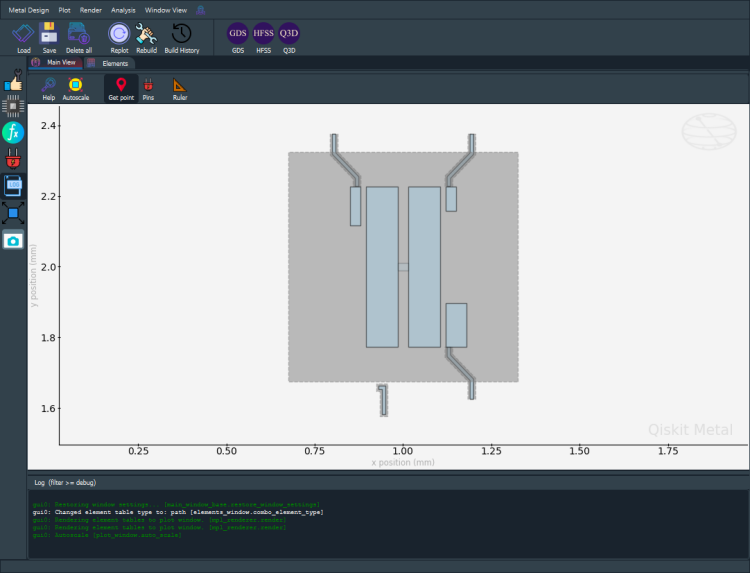
Save screenshot as a .png formatted file.
[9]:
gui.screenshot()
[10]:
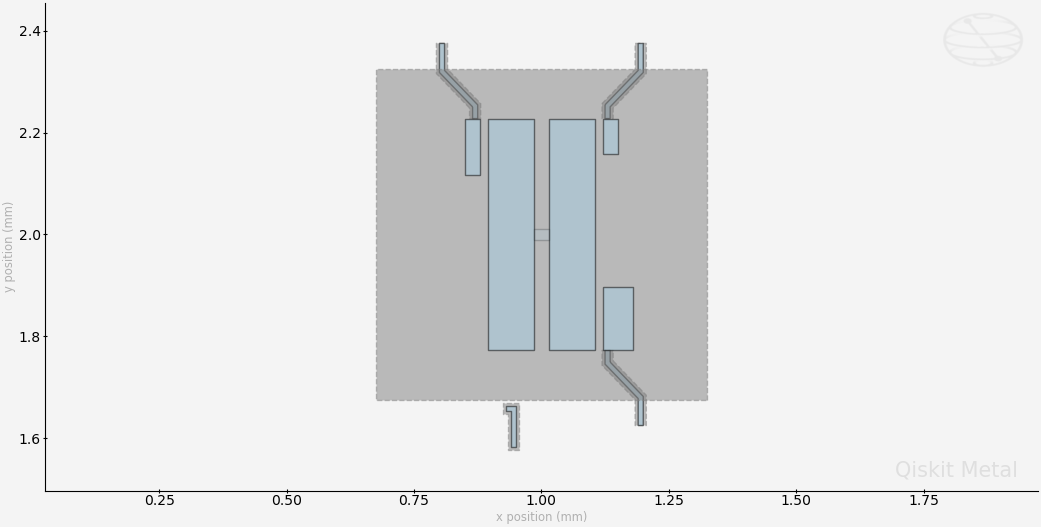
# Screenshot the canvas only as a .png formatted file.
gui.figure.savefig("shot.png")

from IPython.display import Image, display

_disp_ops = dict(width=500)
display(Image("shot.png", **_disp_ops))
Closing the Qiskit Metal GUI
[11]:
gui.main_window.close()
[11]:
True
[ ]:
For more information, review the Introduction to Quantum Computing and Quantum Hardware lectures below
|
Lecture Video | Lecture Notes | Lab |
|
Lecture Video | Lecture Notes | Lab |
|
Lecture Video | Lecture Notes | Lab |
|
Lecture Video | Lecture Notes | Lab |
|
Lecture Video | Lecture Notes | Lab |
|
Lecture Video | Lecture Notes | Lab |