Note
This page was generated from circuit-examples/C.Composite-bi-partite/21-OneTransmonsWithMeanderAndOTG.ipynb.
Transmon coupled to CPW resonator


💡 Running in Colab or Binder? Skip the desktop GUI install — the cell below grabs the lite (no-Qt) wheel, and
qm.gui(design)auto-picks an inline matplotlib viewer with the same API (gui.rebuild(),gui.screenshot(),gui.edit_component(...)) as the desktopMetalGUI.
[ ]:
import qiskit_metal as metal
from qiskit_metal import designs, MetalGUI, Dict
[ ]:
# In Colab / Binder, uncomment to install Quantum Metal (lite, no Qt).
# Locally you should already have it via `pip install quantum-metal` or
# `pip install 'quantum-metal[gui]'` for the desktop GUI.
# !pip install -q quantum-metal
💡 Using this tutorial without the Qt GUI
This tutorial uses the desktop
MetalGUI. To follow along on Colab, Binder, JupyterHub, or any environment where Qt isn’t available, replace any ``gui.rebuild()`` / ``gui.screenshot()`` call with ``qm.view(design)`` — it renders the design to a matplotlibFigureyou can display inline or save withfig.savefig(...).See 1.1 Quick start for a complete runnable walkthrough and
`docs/headless-usage.rst<https://qiskit-community.github.io/qiskit-metal/headless-usage.html>`__ for the full reference.
Create the design in Metal
Setup a design of a given dimension. Dimensions will be respected in the design rendering. Note that the design size extends from the origin into the first quadrant.
[ ]:
design = designs.DesignPlanar({}, True)
design.chips.main.size["size_x"] = "4mm"
design.chips.main.size["size_y"] = "6mm"

gui = MetalGUI(design)
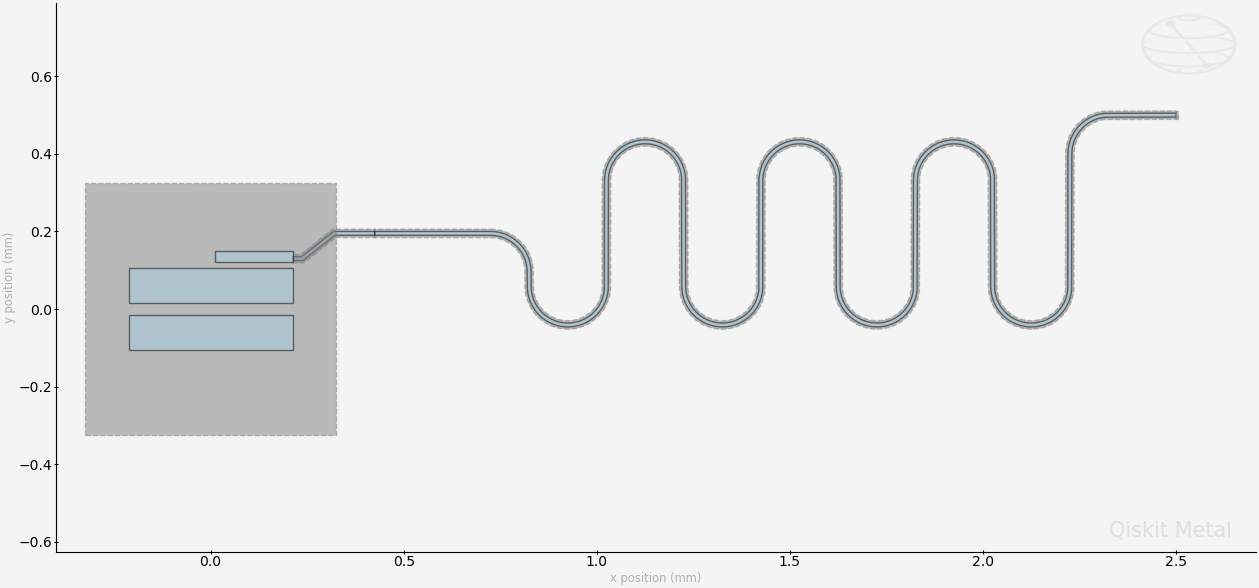
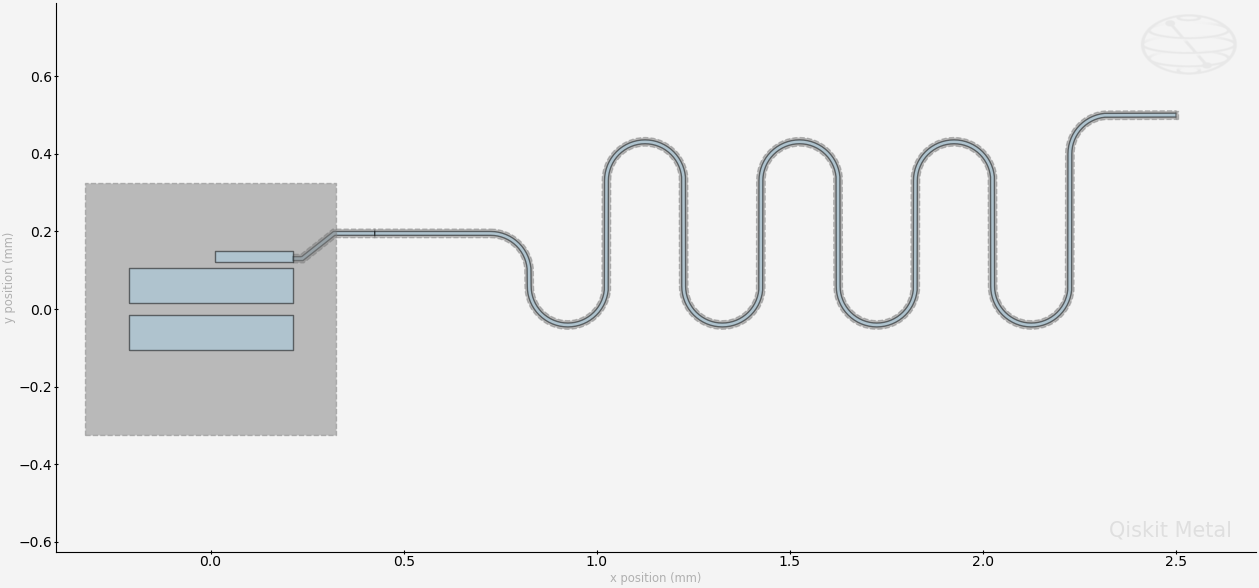
Create one meander resonator connected to a transmons and open-to-ground qcomponents.
[ ]:
from qiskit_metal.qlibrary.qubits.transmon_pocket import TransmonPocket
from qiskit_metal.qlibrary.tlines.meandered import RouteMeander
from qiskit_metal.qlibrary.terminations.open_to_ground import OpenToGround
[4]:
# Explore the options of the OpenToGround.
OpenToGround.get_template_options(design)
[4]:
{'width': '10um',
 'gap': '6um',
 'termination_gap': '6um',
 'pos_x': '0um',
 'pos_y': '0um',
 'orientation': '0',
 'chip': 'main',
 'layer': '1'}
[5]:
# Explore the options of the TransmonPocket.
TransmonPocket.get_template_options(design)
[5]:
{'pos_x': '0um',
 'pos_y': '0um',
 'connection_pads': {},
 '_default_connection_pads': {'pad_gap': '15um',
  'pad_width': '125um',
  'pad_height': '30um',
  'pad_cpw_shift': '5um',
  'pad_cpw_extent': '25um',
  'cpw_width': 'cpw_width',
  'cpw_gap': 'cpw_gap',
  'cpw_extend': '100um',
  'pocket_extent': '5um',
  'pocket_rise': '65um',
  'loc_W': '+1',
  'loc_H': '+1'},
 'pad_gap': '30um',
 'inductor_width': '20um',
 'pad_width': '455um',
 'pad_height': '90um',
 'pocket_width': '650um',
 'pocket_height': '650um',
 'orientation': '0',
 'hfss_inductance': '10nH',
 'hfss_capacitance': 0,
 'hfss_resistance': 0,
 'hfss_mesh_kw_jj': 7e-06,
 'q3d_inductance': '10nH',
 'q3d_capacitance': 0,
 'q3d_resistance': 0,
 'q3d_mesh_kw_jj': 7e-06,
 'gds_cell_name': 'my_other_junction'}
[6]:
# Explore the options of the RouteMeander.
RouteMeander.get_template_options(design)
[6]:
{'pin_inputs': {'start_pin': {'component': '', 'pin': ''},
  'end_pin': {'component': '', 'pin': ''}},
 'fillet': '0',
 'lead': {'start_straight': '0mm',
  'end_straight': '0mm',
  'start_jogged_extension': '',
  'end_jogged_extension': ''},
 'total_length': '7mm',
 'chip': 'main',
 'layer': '1',
 'trace_width': 'cpw_width',
 'meander': {'spacing': '200um', 'asymmetry': '0um'},
 'snap': 'true',
 'prevent_short_edges': 'true'}
[ ]:
# Setup the TransmonPocket loacation and add a connection_pad.
q1 = TransmonPocket(
    design,
    "Q1",
    options=dict(
        pad_width="425 um",
        pocket_height="650um",
        connection_pads=dict(readout=dict(loc_W=+1, loc_H=+1, pad_width="200um")),
    ),
)
[ ]:
# Setup the OpenToGround location and orientation.
otg_options = dict(pos_x="2.5mm", pos_y="0.5mm", orientation="0")

otg = OpenToGround(design, "open_to_ground", options=otg_options)
[ ]:
coupler_options = Dict(
    pin_inputs=Dict(
        start_pin=Dict(component=q1.name, pin="readout"),
        end_pin=Dict(component=otg.name, pin="open"),
    ),
    fillet="99.9um",
    total_length="5mm",
    lead=Dict(start_straight="200um"),
)


bus = RouteMeander(design, "coupler", options=coupler_options)

gui.rebuild()
gui.autoscale()
[ ]:
# Get a list of all the qcomponents in QDesign and then zoom on them.
all_component_names = design.components.keys()

gui.zoom_on_components(all_component_names)
[11]:
# Save screenshot as a .png formatted file.
gui.screenshot()
[12]:
# Screenshot the canvas only as a .png formatted file.
gui.figure.savefig("shot.png")

from IPython.display import Image, display

_disp_ops = dict(width=500)
display(Image("shot.png", **_disp_ops))
[13]:
# Closing the Qiskit Metal GUI
gui.main_window.close()
[13]:
True
[ ]:
For more information, review the Introduction to Quantum Computing and Quantum Hardware lectures below
|
Lecture Video | Lecture Notes | Lab |
|
Lecture Video | Lecture Notes | Lab |
|
Lecture Video | Lecture Notes | Lab |
|
Lecture Video | Lecture Notes | Lab |
|
Lecture Video | Lecture Notes | Lab |
|
Lecture Video | Lecture Notes | Lab |