Note
This is the documentation for the current state of the development branch of Qiskit Experiments. The documentation or APIs here can change prior to being released.
PurityRB
- class PurityRB(physical_qubits, lengths, backend=None, num_samples=3, seed=None, full_sampling=False)[source]
An experiment to characterize the error rate of a gate set on a device using purity RB.
Overview
Purity RB extends
StandardRBby appending post-rotations to the RB sequences to calculate \(\mathrm{Tr}(\rho^2)\), providing an alternative measure of gate fidelity [1].See Qiskit Textbook for an explanation on the RB method.
Note
In 0.5.0, the default value of
optimization_levelintranspile_optionschanged from0to1for RB experiments. That may result in shorter RB circuits hence slower decay curves than before.References
User manual
Analysis class reference
Experiment options
These options can be set by the
set_experiment_options()method.- Options
Defined in the class
StandardRB:lengths (List[int])
Default value:NoneA list of RB sequences lengths.num_samples (int)
Default value:NoneNumber of samples to generate for each sequence length.seed (None or int or SeedSequence or BitGenerator or Generator)
Default value:NoneA seed used to initializenumpy.random.default_rngwhen generating circuits. Thedefault_rngwill be initialized with this seed value every timecircuits()is called.full_sampling (bool)
Default value:NoneIf True all Cliffords are independently sampled for all lengths. If False for sample of lengths longer sequences are constructed by appending additional Clifford samples to shorter sequences.clifford_synthesis_method (str)
Default value:"rb_default"The name of the Clifford synthesis plugin to use for building circuits of RB sequences. See Synthesis Methods.
Defined in the class
BaseExperiment:max_circuits (Optional[int])
Default value:NoneThe maximum number of circuits per job when running an experiment on a backend.
Example
import numpy as np
from qiskit_experiments.library import PurityRB

# Run a 1-qubit PurityRB experiment on qubit 0
lengths = np.arange(1, 400, 80)
num_samples = 3
seed = 1010
qubit = 0

exp = PurityRB((qubit,), lengths, num_samples=num_samples, seed=seed)
expdata = exp.run(backend=backend).block_for_results()
results = expdata.analysis_results(dataframe=True)

display(expdata.figure(0))
print(f"Purity EPC: {results.loc[results['name'] == 'EPC_pur', 'value'].values[0]:.5f}")
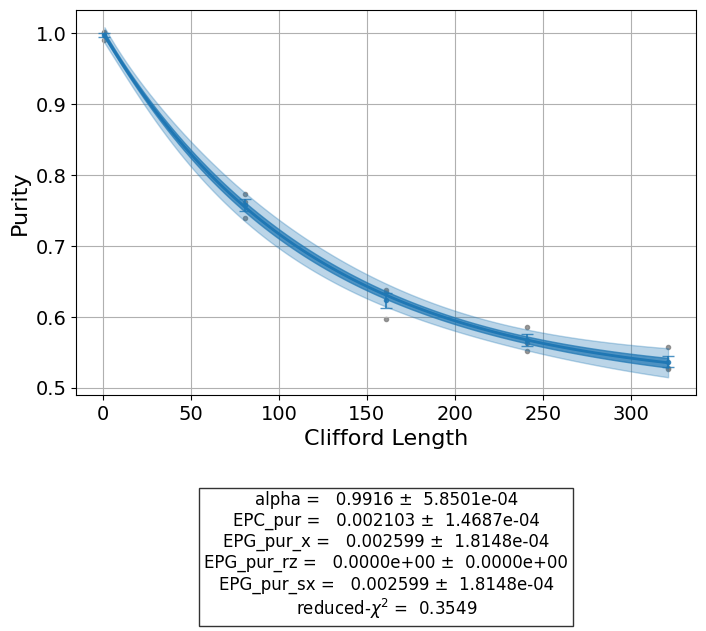
Purity EPC: 0.00215+/-0.00008
See also
Initialization
Initialize a purity randomized benchmarking experiment.
- Parameters:
physical_qubits – List of physical qubits for the experiment.
lengths – A list of RB sequences lengths.
backend – The backend to run the experiment on.
num_samples – Number of samples to generate for each sequence length.
seed – Optional, seed used to initialize
numpy.random.default_rng. when generating circuits. Thedefault_rngwill be initialized with this seed value every timecircuits()is called.full_sampling – If True all Cliffords are independently sampled for all lengths. If False for sample of lengths longer sequences are constructed by appending additional samples to shorter sequences. The default is False.
- Raises:
QiskitError – If any invalid argument is supplied.
Attributes
- analysis
Return the analysis instance for the experiment
- backend
Return the backend for the experiment
- experiment_options
Return the options for the experiment.
- experiment_type
Return experiment type.
- num_qubits
Return the number of qubits for the experiment.
- physical_qubits
Return the device qubits for the experiment.
Methods
- circuits()[source]
Return a list of RB circuits.
- Returns:
A list of
QuantumCircuit.- Return type:
List[QuantumCircuit]
- config()
Return the config dataclass for this experiment
- Return type:
- copy()
Return a copy of the experiment
- Return type:
- classmethod from_config(config)
Initialize an experiment from experiment config
- Return type:
- job_info(backend=None)
Get information about job distribution for the experiment on a specific backend.
- Parameters:
backend (Backend) – Optional, the backend for which to get job distribution information. If not specified, the experiment must already have a set backend.
- Returns:
A dictionary containing information about job distribution.
”Total number of circuits in the experiment”: Total number of circuits in the experiment.
”Maximum number of circuits per job”: Maximum number of circuits in one job based on backend and experiment settings.
”Total number of jobs”: Number of jobs needed to run this experiment on the currently set backend.
- Return type:
dict
- Raises:
QiskitError – if backend is not specified.
- run(backend=None, sampler=None, analysis='default', timeout=None, backend_run=None, **run_options)
Run an experiment and perform analysis.
- Parameters:
backend (Backend | None) – Optional, the backend to run on. Will override existing backend settings.
sampler (BaseSamplerV2 | None) – Optional, the sampler to run the experiment on. If None then a sampler will be invoked from previously set backend
analysis (BaseAnalysis | None) – Optional, a custom analysis instance to use for performing analysis. If None analysis will not be run. If
"default"the experimentsanalysis()instance will be used if it contains one.timeout (float | None) – Time to wait for experiment jobs to finish running before cancelling.
backend_run (bool | None) – Use backend run (temp option for testing)
run_options – backend runtime options used for circuit execution.
- Returns:
The experiment data object.
- Raises:
QiskitError – If experiment is run with an incompatible existing ExperimentData container.
- Return type:
- set_experiment_options(**fields)
Set the experiment options.
- Parameters:
fields – The fields to update the options
- Raises:
AttributeError – If the field passed in is not a supported options
- set_run_options(**fields)
Set options values for the experiment
run()method.- Parameters:
fields – The fields to update the options
See also
The Setting options for your experiment guide for code example.
- set_transpile_options(**fields)
Set the transpiler options for
run()method.- Parameters:
fields – The fields to update the options
- Raises:
QiskitError – If initial_layout is one of the fields.
See also
The Setting options for your experiment guide for code example.